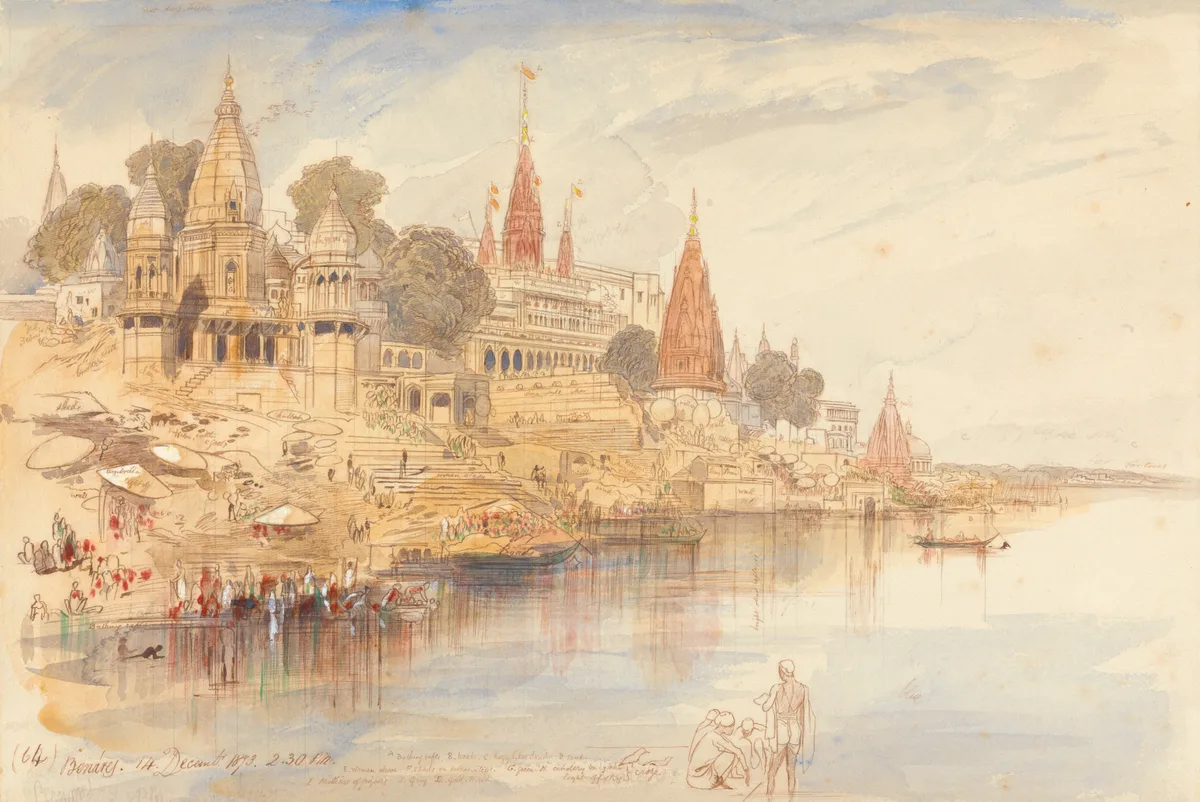
History of Kashi: One of the World's Oldest Living Cities
Older than history, older than tradition — the city that exists outside of time
Kashi is believed to be one of the oldest continuously inhabited cities on earth — a claim supported not only by Hindu scripture (which says it existed before time began) but by archaeological evidence of settled habitation dating back approximately 3,000 years, and ancient texts that describe a vibrant city well before the first millennium BCE. To understand Varanasi is to stand at the confluence of the oldest continuous human civilisation and its most living religious tradition.
The Ancient City: From Vedic Times to the Buddha
The name Kashi (from 'kash', to shine) appears in the Atharva Veda and the Mahabharata — placing it firmly within the oldest stratum of Indo-Aryan textual culture. The city appears as a prosperous kingdom (the Kashi Mahajanapada) in early Buddhist texts, which describe it as one of sixteen great kingdoms of northern India in the 6th–4th centuries BCE.
The most significant historical event connecting Kashi to the outside world is the journey of the young Siddhartha Gautama (who would become the Buddha) from his kingdom to this region. After attaining Enlightenment at Bodhgaya (250 km west), the Buddha travelled to Sarnath — a small town 12 km north of Varanasi — to deliver his first sermon. The Dharmachakra Pravartana ('turning of the wheel of dharma') at Sarnath is one of Buddhism's most sacred events, and it happened in the shadow of Kashi.
Archaeological excavations at Rajghat (the mound at the northern end of Varanasi's ghat stretch) have revealed continuous habitation from approximately 1,000 BCE, with earlier evidence of pre-urban settlement before that.
The Medieval Period: Temple Cities and Muslim Rule
Varanasi in the medieval period was a city of extraordinary temples — ancient texts describe thousands of shrines within the city's boundaries. The arrival of Muslim rulers in north India from the 12th century onwards brought repeated cycles of temple destruction and reconstruction.
The most significant single act of destruction was Aurangzeb's 1669 demolition of the original Kashi Vishwanath temple and construction of the Gyanvapi Mosque on part of the site. This event, and the adjacent history, defines the most contested dimension of Varanasi's heritage.
The Mughal period also brought positive contributions to Varanasi's culture — the development of the Banaras Gharana of music, the patronage of Banarasi silk weaving, and the presence of Sufi saints who found in Varanasi a space for their contemplative traditions. The poet-saint Kabir — one of India's greatest spiritual figures, whose verses are read across all religions — was born and lived in Varanasi in the 15th century, and his philosophy of transcending Hindu-Muslim boundaries was shaped in large part by this city.
Reconstruction and the Modern City
The 18th century saw a major reconstruction of Varanasi's religious infrastructure, patronized primarily by Maratha rulers (Peshwas, Holkar, Scindia) who considered the rebuilding of Kashi's temples a sacred duty. Rani Ahilya Bai Holkar of Indore, who reconstructed the Kashi Vishwanath Temple in 1780, is the most celebrated figure of this restoration.
The British colonial period (19th–mid-20th century) layered another stratum onto the city — colonial-era bungalows and cantonment areas, English-medium schools, a railway station, and eventually Banaras Hindu University (BHU, founded 1916), one of Asia's largest residential universities.
Independent India's Varanasi has continued to evolve while maintaining its ancient character. The 2021 Kashi Vishwanath Corridor has most recently transformed the most sacred space. The city remains simultaneously one of India's most modern-aspiring urban areas and its most ancient living heritage.
Frequently Asked Questions
Is Varanasi really one of the world's oldest cities?▼
Archaeological evidence places continuous habitation at Varanasi from approximately 1,000 BCE, making it at least 3,000 years old. Some estimates extend to 4,000+ years. This places it among the oldest continuously inhabited cities in the world — comparable to Athens, Jerusalem, or Luxor. The Hindu scriptural tradition places its founding before recorded time.