Banarasi Silk: The 2,000-Year Weaving Tradition of Varanasi
India's most celebrated hand-woven textile — protected by geographical indication since 2009
Banarasi silk sarees are among the most prized textiles in India — worn at weddings, gifted at celebrations, collected as heirlooms, and referenced in classical literature and Mughal court records. The craft has been practised in Varanasi for at least 2,000 years, with Mughal patronage (16th–18th centuries) elevating it to its current height of technical refinement. In 2009, Banarasi sarees received a Geographical Indication (GI) registration — meaning only sarees woven in the Varanasi region can legally be called 'Banarasi.'
The History of Banarasi Weaving
Varanasi's textile tradition predates the Mughal period substantially, but it was under Mughal influence — particularly from the 16th to 18th centuries — that the characteristic Banarasi aesthetic developed. Mughal taste introduced Persian-inspired floral motifs (jangla, butidar patterns), the use of real gold and silver wire (zari), and the elaborate brocade techniques that define the most formal Banarasi sarees.
The weavers of Varanasi — predominantly from the Muslim Ansari community, who have maintained this craft across generations — absorbed these influences and developed them into a distinctly subcontinental idiom. By the 18th century, Banarasi sarees were being worn by Mughal royalty and regional courts across India.
The British colonial period brought both disruption (through imported mill-made textiles) and eventually renewed appreciation, as the Arts and Crafts movement internationally created demand for handmade goods. Banarasi weaving survived and continues today in the hands of tens of thousands of weavers, though the craft faces challenges from cheap machine-made imitations.
How Banarasi Sarees Are Made
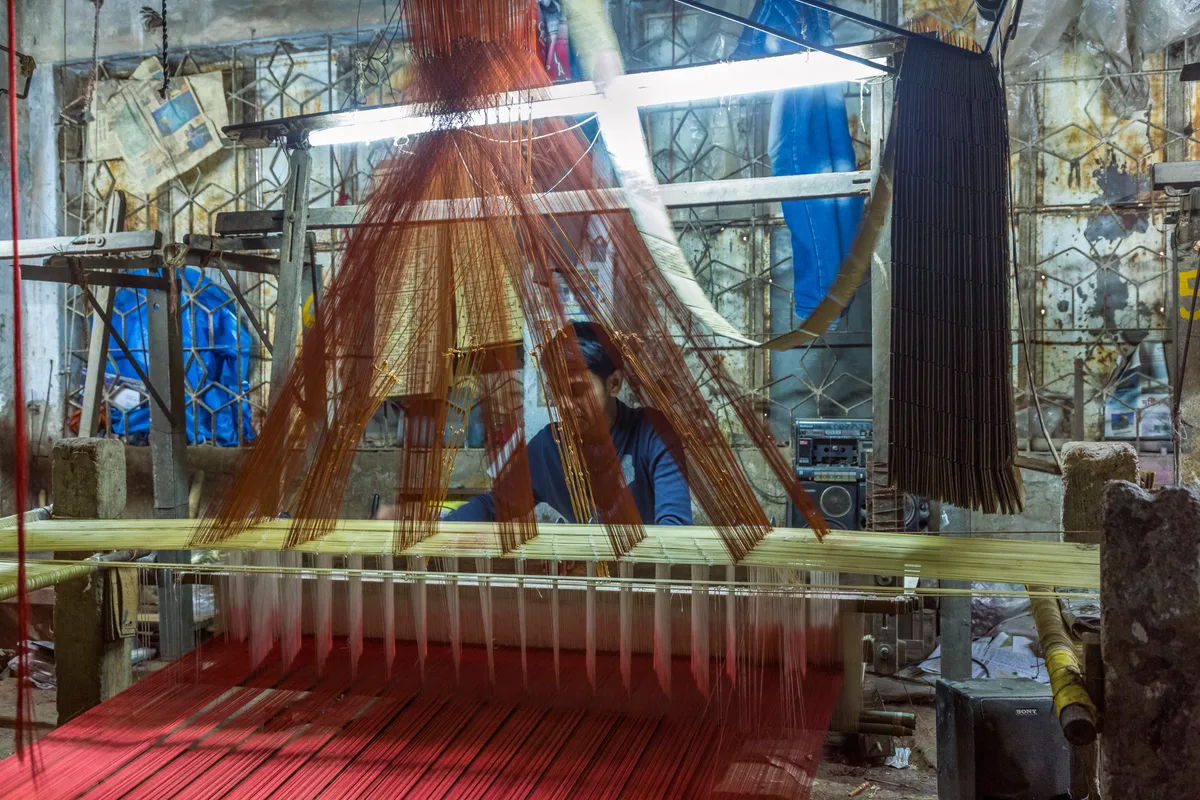
The weaving of a Banarasi saree is done on a handloom, by skilled weavers (karkhanadar) who typically work in pairs — one managing the warp threads and one operating the shuttle. The most elaborate designs require wooden punch-cards (jacquard mechanism) or, in modern workshops, computer-assisted jacquard systems.
The pure silk versions use locally twisted silk threads (both on the warp and weft). The zari work uses thin gold or silver wire wrapped around a silk or cotton core. A simple Banarasi saree with minimal zari work takes 2–3 days to weave. An elaborate heavy bridal saree — covered entirely with intricate zari patterns — can take up to 6 months for a single weaver pair.
The four main types of Banarasi sarees: Pure Katan Silk (the most traditional; tightly woven, fine, and heavy), Organza with zari and silk (Kora), Georgette Banarasi (lighter, more contemporary wearability), and Shattir (a coarser fabric with less zari).
Identifying Genuine Banarasi Silk and Where to Buy
The proliferation of machine-made imitations from Surat, Gujarat and from power looms in Varanasi's periphery means that buyers must know how to identify genuine handwoven Banarasi silk.
Tests for silk authenticity: Burn a thread from an inconspicuous section — genuine silk smells like burning hair and leaves a powdery ash; synthetic fibres melt and form a hard bead. The feel of genuine silk is cool and smooth, not slippery.
For zari authenticity: Real zari (gold/silver wire) is more expensive; much contemporary Banarasi uses metallic thread that mimics zari without the precious metal content. This is acceptable if the price reflects it — only misrepresentation is the issue.
Where to buy: The Varanasi Silk Expo (government emporium near Dashaswamedh) sells verified genuine products at fixed prices — a good benchmark for quality and price. Private silk shops in the Vishwanath Gali and Godaulia areas range from excellent to fraudulent. The established weaving areas — Madanpura, Lohta, Lallapura — allow visitors to see the weaving process and buy directly from the source with Spirit of Kashi coordination. Prices for genuine handloom Banarasi sarees start around ₹3,000–5,000 for simple designs and extend to ₹50,000+ for elaborate bridal pieces.
Frequently Asked Questions
Is it safe to buy Banarasi sarees on the street or from touts?▼
No — buying from touts who approach you on the street and invite you to a 'government emporium' or a relative's shop is the primary scam targeting tourists in Varanasi. The shops accessed this way are typically selling machine-made imitations at hand-loom prices. Buy from established shops you have selected yourself, or from government-certified emporia, or with Spirit of Kashi guidance to verified workshops.